Introduction: More Than Ink and Stone
In traditional Chinese culture, writing was never seen as a purely technical skill. It was a path of self-cultivation, moral discipline, and inner balance. At the center of this practice stood the inkstone, and among all inkstones, Duan inkstone held a uniquely respected position.
To understand why Duan inkstone is often regarded as the soul of Chinese scholar culture, we must look beyond its function and explore its cultural, philosophical, and symbolic significance.
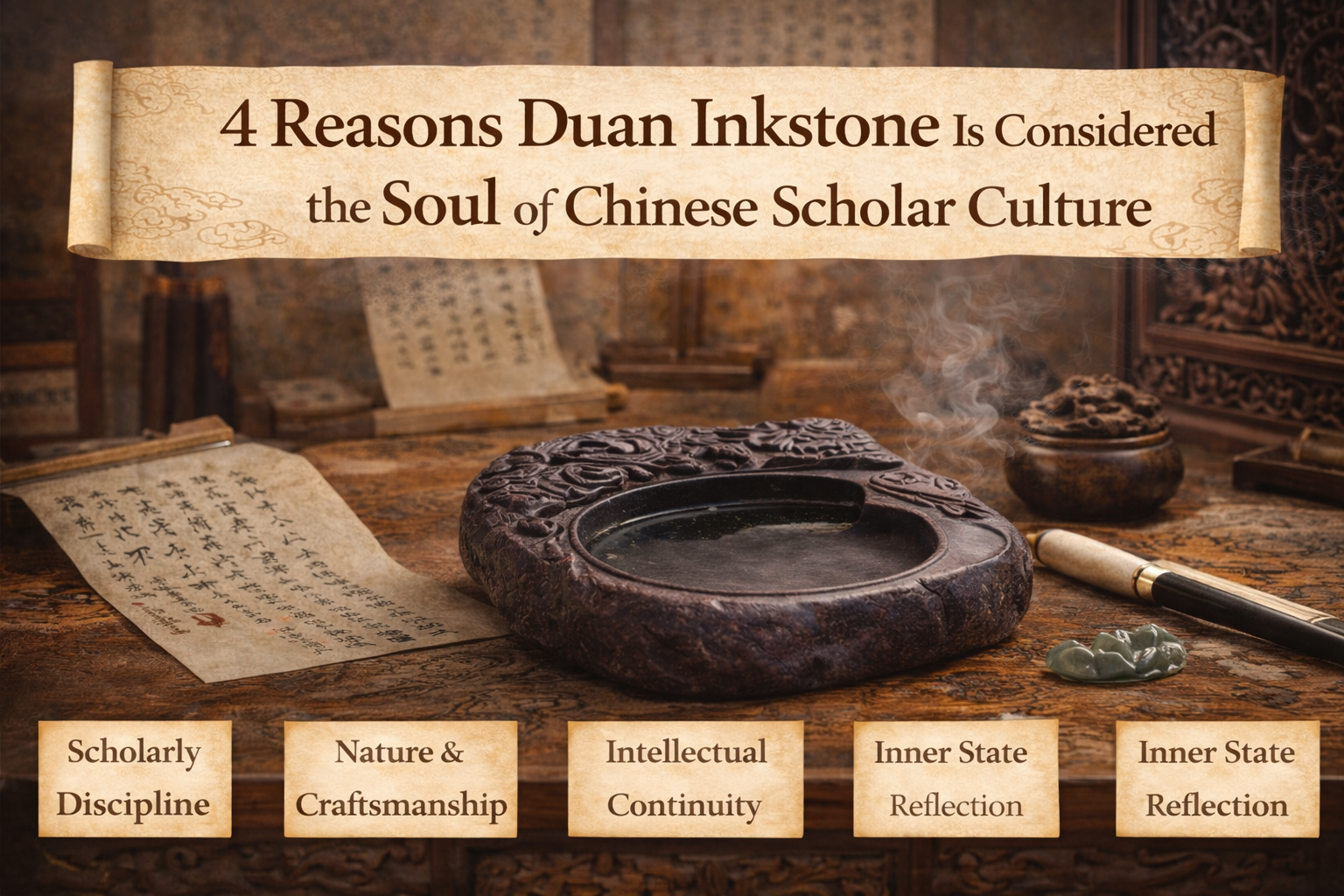
1. Duan Inkstone Represents Scholarly Discipline, Not Convenience
Unlike brushes or paper, which are consumed through use, an inkstone remains constant. Grinding ink requires time, patience, and focus. This ritual was seen by scholars as a form of mental preparation before writing.
Duan inkstone, valued for its smooth texture and controlled ink release, reinforces this discipline. It reminds the scholar that learning is not rushed, and wisdom is cultivated through consistency rather than speed.
2. Duan Inkstone Connects Nature and Human Craftsmanship
Duan inkstone is carved from natural stone formed over millions of years. Traditional craftsmen emphasize following the stone, rather than forcing shape or decoration upon it.
This philosophy reflects a core Chinese value: harmony between nature and human intention. In scholar culture, this harmony mirrors the ideal relationship between thought and expression.
Each Duan inkstone carries unique textures and patterns, reinforcing the idea that no two paths of learning are identical.
3. Duan Inkstone Symbolizes Intellectual Lineage and Continuity
In many scholarly families, inkstones were passed down through generations. Unlike tools meant for replacement, Duan inkstones were regarded as companions of learning, absorbing time, effort, and memory.
This continuity gave the inkstone a symbolic role as a bridge between past and present. Scholars believed that studying with such objects reinforced respect for tradition while encouraging personal refinement.
4. Duan Inkstone Reflects the Scholar’s Inner State
In Chinese philosophy, external objects often mirror internal conditions. A calm, well-maintained inkstone was thought to reflect a composed and disciplined mind.
Because Duan inkstone responds sensitively to pressure and movement, it rewards attentiveness and punishes haste. This interaction reinforced self-awareness and restraint—qualities central to scholar culture.
Over time, the inkstone became less of a tool and more of a silent teacher, shaping both writing and character.
Conclusion: Why Duan Inkstone Still Matters Today
Duan inkstone remains significant not because of nostalgia, but because it embodies values that transcend time: patience, balance, respect for craft, and thoughtful expression.
In a fast-paced modern world, Duan inkstone continues to serve as a cultural reminder that meaningful creation begins with stillness and intention.