Lion dance is one of the most recognizable symbols of Chinese culture.
But not all lion dances are the same.
In fact, there are two primary styles: Northern Lion Dance and Southern Lion Dance. While both share a common cultural root, their appearance, movement, symbolism, and ceremonial use differ significantly.
Understanding these differences helps explain why certain styles are used for weddings, business openings, festivals, and modern performances.
Origins and Historical Background
Northern Lion Dance
Northern lion dance originated in Northern China and has strong ties to imperial court entertainment. Historically, it was performed in royal celebrations and military displays.
It emphasizes:
- Acrobatics
- Athletic movement
- Entertainment spectacle
It reflects the northern tradition of martial arts and physical performance.
Southern Lion Dance
Southern lion dance developed in Southern China, particularly in Guangdong province. It is deeply connected to community rituals and symbolic ceremonies.
It emphasizes:
- Symbolic gestures
- Ritual interaction
- Spiritual meaning
Southern lion dance is the style most commonly seen in weddings, grand openings, and Lunar New Year celebrations.
Visual Differences
One of the easiest ways to distinguish the two styles is appearance.
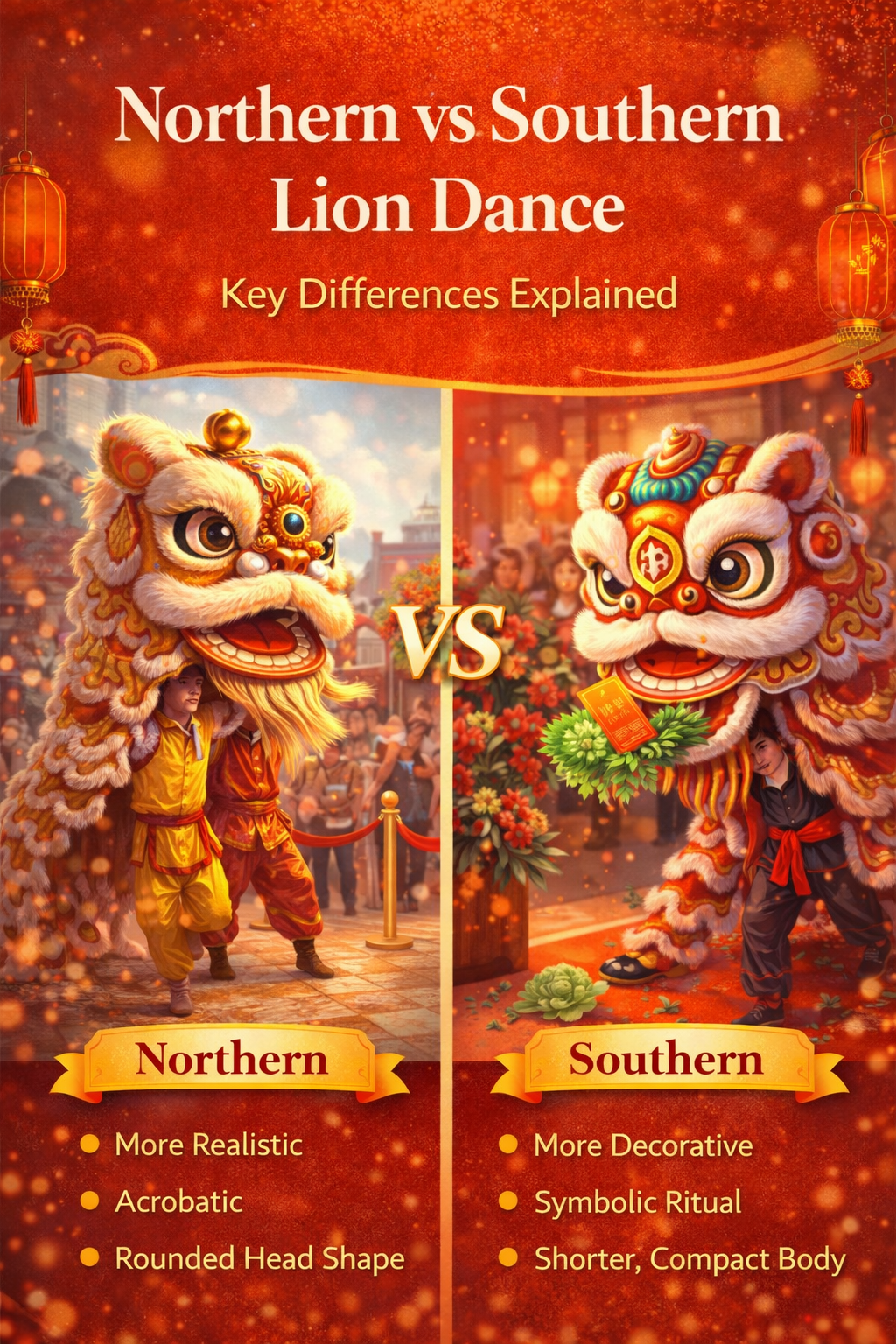
Northern Lion Appearance
- Often appears in pairs (male and female)
- Fur-heavy design
- More realistic lion features
- Rounded head shape
- Longer body
Northern lions resemble traditional Chinese guardian statues more closely.
Southern Lion Appearance
- Bright, expressive face
- Large blinking eyes
- Decorative forehead mirror
- Prominent horn
- Shorter, more compact body
Southern lions are highly stylized and theatrical.
Performance Style Differences
Northern Lion Dance Style
Northern lion dance is acrobatic and energetic. It includes:
- High jumps
- Platform balancing
- Complex footwork
- Playful interaction between paired lions
It often resembles a circus-like athletic performance.
Southern Lion Dance Style
Southern lion dance focuses on emotional storytelling.
The lion expresses:
- Curiosity
- Anger
- Playfulness
- Respect
Movements are deliberate and symbolic rather than purely athletic.
This is why Southern lion dance is preferred for:
- Business openings
- Wedding ceremonies
- Religious blessings
It carries deeper ritual meaning.
Symbolism and Cultural Meaning
Both styles represent strength and protection, but their emphasis differs.
Northern Lion Symbolism
- Celebration
- Entertainment
- National performance culture
It reflects imperial and festive heritage.
Southern Lion Symbolism
- Prosperity
- Protection
- Spiritual cleansing
- Financial success
Southern lion dance is deeply tied to rituals like Cai Qing (Plucking the Greens) — especially important in business ceremonies.
Geographic Influence
- Northern style dominates in Northern China.
- Southern style is common in Guangdong, Hong Kong, and overseas Chinese communities.
Internationally, Southern lion dance is more widely recognized because it spread with Cantonese migration.
Use in Modern Contexts
Today:
Southern lion dance is used in:
- Grand openings
- Weddings
- Lunar New Year
- Corporate ceremonies
Northern lion dance is more often seen in:
- Stage performances
- Cultural festivals
- Martial arts showcases
Understanding this distinction explains why you rarely see Northern lions at store openings.
Costume and Design Differences
Even the costume construction differs.
Northern lions:
- Focus on realism
- Heavier fur
- Two-person synchronized movements
Southern lions:
- Emphasize facial expression
- Feature symbolic elements (mirror, horn)
- Allow expressive head movement
The Southern lion head is more compact and theatrical.
Which Style Is More Popular Today?
Globally, Southern lion dance is more visible because:
- It fits ceremonial contexts
- It is more visually dramatic
- It integrates easily into modern celebrations
However, both styles remain culturally significant.
Why Understanding the Difference Matters
When people search “lion dance,” they often assume it is a single tradition.
In reality, it is a cultural family of performance styles shaped by geography, history, and symbolism.
Recognizing the difference helps deepen appreciation for:
- Cultural heritage
- Ritual meaning
- Artistic design
And it explains why lion symbolism appears in modern decor, charms, and cultural products — most of which are inspired by the Southern lion tradition.