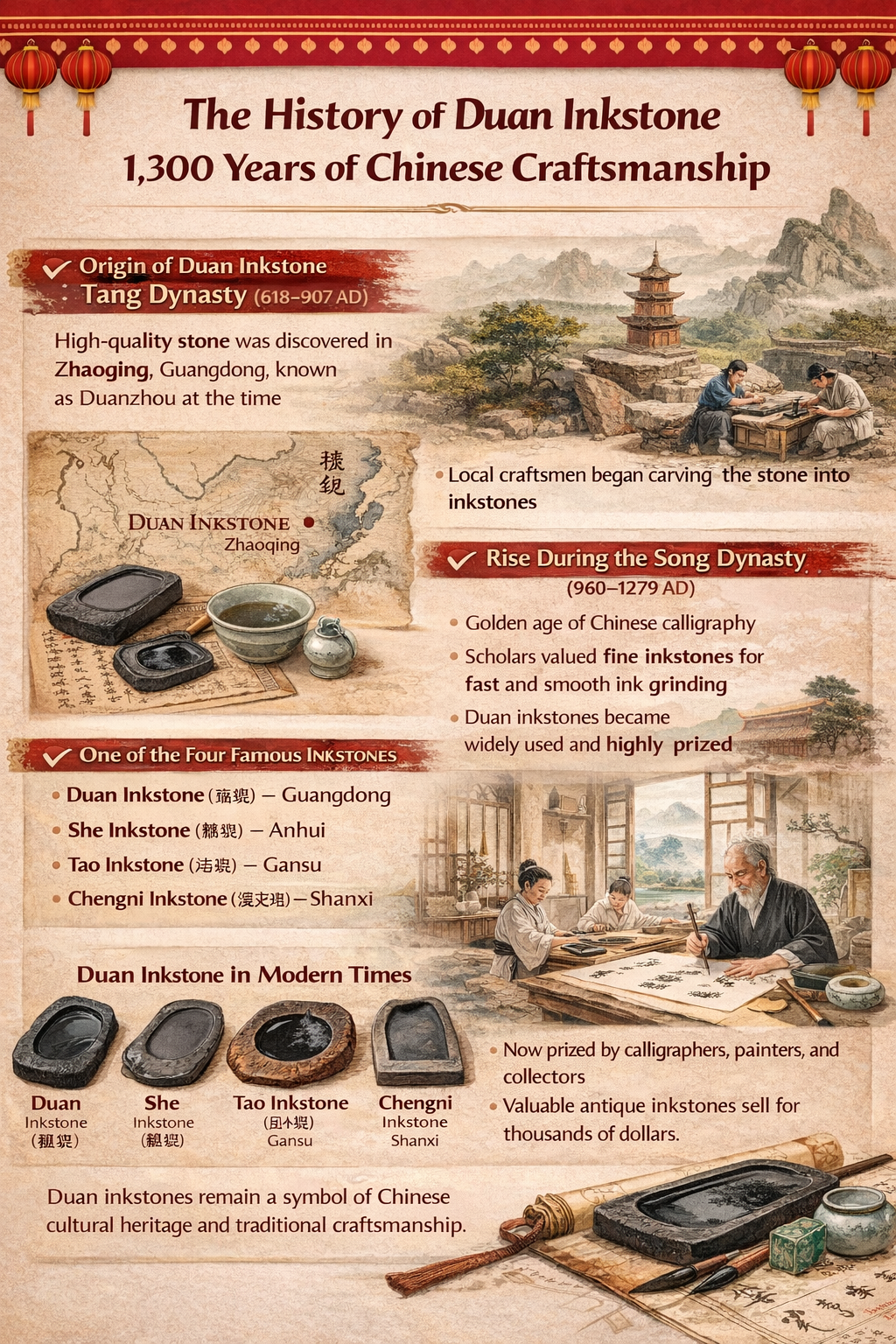
For more than a thousand years, the Duan inkstone has been one of the most respected tools in Chinese calligraphy and painting. Known for its smooth texture and excellent ink grinding performance, the Duan inkstone is widely regarded as one of the finest inkstones in Chinese history.
Originating from Zhaoqing in Guangdong Province, this traditional inkstone has been used by scholars, artists, and collectors for over 1,300 years.
Today, Duan inkstones remain an important symbol of Chinese cultural heritage and traditional craftsmanship.
Origins of Duan Inkstone in the Tang Dynasty
The history of the Duan inkstone dates back to the Tang Dynasty (618–907 AD).
During this period, high-quality stone was discovered in the mountains of Duanzhou, the ancient name for modern-day Zhaoqing.
Local craftsmen began carving this stone into inkstones for scholars and officials. Because the stone had an exceptionally fine and dense texture, it allowed ink to be ground smoothly and efficiently.
By the late Tang Dynasty, Duan inkstones had already gained recognition as one of the finest writing tools in China.
Rise of Duan Inkstone During the Song Dynasty
The popularity of Duan inkstones grew significantly during the Song Dynasty (960–1279 AD).
This period is often considered the golden age of Chinese calligraphy and scholarship. Scholars placed great importance on the tools used in writing and painting.
Duan inkstones became highly valued because they:
- grind ink quickly
- produce smooth, rich ink
- do not damage brush tips
Many famous scholars and artists preferred Duan inkstones over other types of inkstones.
Duan Inkstone as One of the Four Famous Inkstones
Over time, Duan inkstone became recognized as one of the Four Famous Inkstones of China.
These include:
- Duan Inkstone (端砚) – Guangdong
- She Inkstone (歙砚) – Anhui
- Tao Inkstone (洮砚) – Gansu
- Chengni Inkstone (澄泥砚) – Shanxi
Among them, Duan inkstone is often regarded as the most refined and elegant due to its smooth stone quality.
Unique Characteristics of Duan Stone
The stone used to create Duan inkstones comes from specific quarries in Zhaoqing.
This natural stone is known for:
- extremely fine texture
- high durability
- smooth grinding surface
- ability to produce rich ink quickly
Some Duan stones also contain unique natural patterns known as:
- Stone Eye (石眼)
- Banana Leaf White (蕉叶白)
- Fire Mark (火捺)
These natural features often increase the artistic and collectible value of the inkstone.
Duan Inkstone in Chinese Scholar Culture
For centuries, the Duan inkstone was an essential part of the Four Treasures of the Study.
These traditional tools include:
- brush
- ink
- paper
- inkstone
Together, they formed the foundation of Chinese calligraphy and painting.
Many scholars believed that a high-quality inkstone could improve both the ink quality and writing experience.
Duan Inkstone in Modern Times
Even in the modern era, Duan inkstones continue to be valued by:
- calligraphers
- painters
- collectors
- cultural enthusiasts
Some antique Duan inkstones are now considered valuable cultural artifacts and can sell for thousands of dollars at auctions.
At the same time, contemporary craftsmen in Zhaoqing still produce handmade Duan inkstones using traditional carving techniques passed down for generations.
Why Duan Inkstone Still Matters Today
Although modern bottled ink is widely available, many artists still prefer using an inkstone.
Grinding ink manually allows greater control over the ink’s thickness and texture.
More importantly, the process of grinding ink is seen as a meditative ritual that connects artists with centuries of Chinese artistic tradition.
For this reason, the Duan inkstone continues to hold a special place in Chinese cultural heritage.